
If you’ve spent any time looking for TradingView indicators, you’ve probably come across LuxAlgo. What began as a collection of technical-analysis tools has expanded into a broader platform with AI-assisted strategy creation, backtesting, alerts, native charting, and TradingView indicator suites. That growth has also made it harder to decide whether a paid subscription is worth the investment.
This LuxAlgo review for 2026 looks at what the platform actually offers today, how its core tools work, where it excels, and where it may not be the best fit. Rather than asking whether any indicator can consistently predict the market, we’ll focus on a more practical question:
is LuxAlgo worth it for the way you trade?
The short answer is yes – for the right trader.
LuxAlgo combines confirmation and contrarian trading signals, indicator overlays, market-structure analysis, momentum tools, configurable alerts, screeners, and AI-assisted strategy development into a single ecosystem. Traders who enjoy customizing every aspect of their analysis may appreciate that breadth. Others may prefer a platform like ChartPrime that presents technical information through a more structured workflow with fewer configuration decisions.
It’s also important to keep expectations realistic. This review evaluates LuxAlgo’s features, usability, and value – not its ability to guarantee profitable trades. No indicator suite can remove market risk, replace sound risk management, or eliminate the need for testing a strategy under real market conditions.
|
Category |
Assessment |
|
Best for |
Traders who want extensive customization and multiple technical-analysis tools |
|
Main strength |
Combines signals, overlays, market structure, alerts, screeners, and AI tools in one platform |
|
Main limitation |
The number of available features creates a steeper learning curve than many competing products |
|
Platform fit |
Strong TradingView integration with an expanding native AI platform |
|
Beginner-friendly |
Presets help shorten setup, but mastering the platform takes time |
|
Automated trading |
Supports alerts, AI strategy creation, and backtesting, but users remain responsible for execution and risk management |
|
Alternative to consider |
ChartPrime for traders who prefer structured visual workflows and a focused collection of TradingView tools |
Before subscribing, remember that LuxAlgo pricing, available plans, and included features can change over time. The comparisons in this LuxAlgo subscription review reflect the platform as it exists in 2026, but it’s always worth confirming current subscription details before purchasing.
What is LuxAlgo?
LuxAlgo is a technical-analysis platform designed to help traders interpret price action, identify trends, monitor momentum, and evaluate potential trade setups. While it’s best known for its TradingView indicators, this LuxAlgo indicators review focuses on its expansion beyond a single indicator suite to include AI-assisted strategy development, backtesting, native charting tools, alerts, screeners, and market-analysis features.
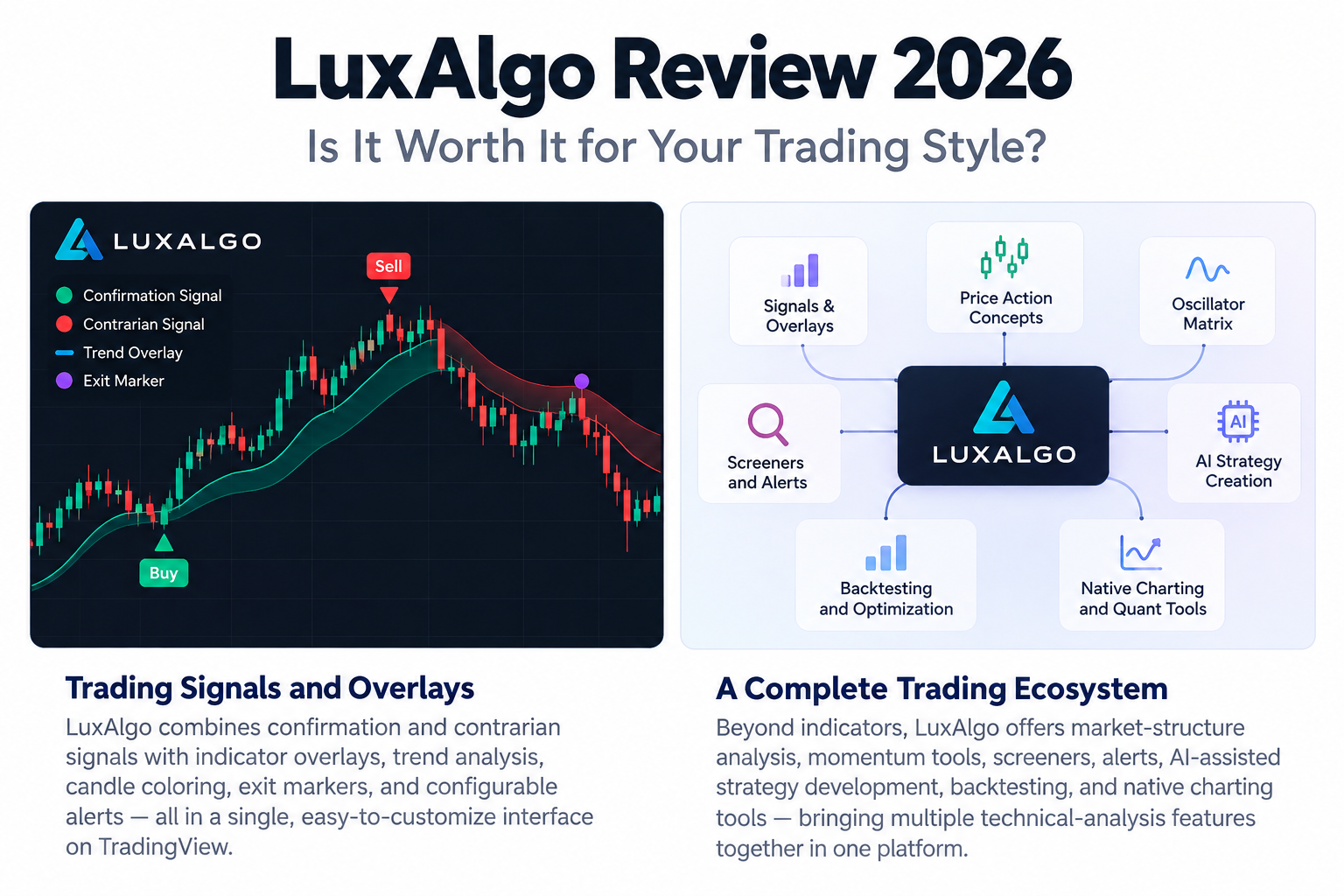
One of its most widely used products is LuxAlgo Signals and Overlays, a toolkit that combines trading signals with indicator overlays, dashboards, candle coloring, exit markers, and configurable alerts. Rather than requiring traders to assemble dozens of separate indicators, it groups related tools into a single interface that can be tailored to different trading styles.
Today, the broader LuxAlgo ecosystem includes several categories of tools, including:
- Signals & Overlays for trend-following and reversal signals, overlays, and exits
- Price Action Concepts for analyzing market structure, liquidity, and important price levels
- Oscillator Matrix for evaluating momentum and potential overbought or oversold conditions
- Screeners and alerts for monitoring multiple symbols and notifying traders when predefined conditions occur
- AI-assisted strategy creation and backtesting for building, testing, and refining trading ideas
- Native charting and Quant tools that extend analysis beyond TradingView
Not every feature is included with every subscription, and LuxAlgo periodically updates its plans. Before subscribing, confirm which tools are included in the tier you’re considering.
How LuxAlgo Signals Work
At the center of LuxAlgo Signals and Overlays are two different approaches to identifying potential trade opportunities: confirmation signals and contrarian signals. Rather than competing with one another, they’re designed for different market conditions and trading styles.
Confirmation signals follow the prevailing trend. Instead of trying to predict where a reversal might occur, they look for technical conditions that support an existing directional move. Strong confirmation signals align with LuxAlgo’s trend analysis, making them a better fit for traders who prefer waiting for momentum to develop before entering a position.
Contrarian signals take the opposite approach. They attempt to identify areas where a trend may be losing strength and a reversal could be developing. That can produce earlier entries, but it also means traders may be stepping against established momentum if the trend continues.
The toolkit also includes signal-strength classifications, suggested exit markers, candle coloring, configurable filters, and indicator overlays that provide additional context around each setup. Rather than treating every label as a trading instruction, these features help traders evaluate whether a signal aligns with the broader market picture.
LuxAlgo’s own documentation encourages users to combine its signals with other forms of technical analysis instead of relying on any single indicator. The platform identifies technical conditions that may deserve attention, but it’s still up to traders to decide whether those conditions support a trade.
LuxAlgo’s Main Features in 2026
Signals and Exits
Signals & Overlays remains LuxAlgo’s flagship toolkit. It generates bullish and bearish confirmation signals that align with the prevailing trend, along with contrarian signals that attempt to identify potential reversals. Strong signal labels help indicate when technical conditions more closely align with the platform’s underlying trend analysis, while suggested exit markers highlight areas where a trade may be losing momentum. These labels are designed to identify technical conditions – not provide automatic buy or sell instructions – so traders still need to evaluate each setup within the broader market context. Like any technical indicator, LuxAlgo signals accuracy depends on market conditions, timeframe, and how traders incorporate those signals into a broader strategy.
Indicator Overlays
Beyond its trading signals, LuxAlgo offers a collection of overlays that add context directly to the chart. Depending on the tools enabled, traders can visualize trend direction, dynamic support and resistance, trailing levels, volatility, channels, and potential reversal areas. These overlays work alongside the platform’s signals or independently, allowing traders to build a workflow that matches their preferred style.
Price Action and Market Structure
LuxAlgo’s Price Action Concepts toolkit focuses on how price moves rather than simply where it moves. It highlights structural shifts, liquidity concepts, order blocks, imbalances, and other areas that many traders monitor when evaluating trend continuation or possible reversals. Instead of replacing chart analysis, these tools help organize information that traders often identify manually, making it easier to recognize recurring market behavior.
Oscillator and Momentum Analysis
Momentum indicators answer a different question than trend indicators: not whether price is moving, but how strongly it’s moving. LuxAlgo’s oscillator tools help traders evaluate momentum, identify potential overbought or oversold conditions, and monitor divergence between price and momentum. Many traders use this information as additional confirmation before acting on other technical signals rather than treating it as a standalone trading system.
Alerts and Screeners
Monitoring dozens of charts isn’t practical for most traders, which is where LuxAlgo’s alerts and screening tools become useful. Configurable TradingView alerts can notify users when selected technical conditions occur, while screeners scan multiple symbols and timeframes for matching setups. Instead of constantly watching charts, traders can focus their attention on opportunities that meet their predefined criteria.
AI Strategy and Backtesting Tools
LuxAlgo’s newer AI-assisted strategy creation and LuxAlgo backtesting tools are designed to help traders explore, refine, and evaluate trading ideas before risking real capital. Backtesting can reveal how a rules-based strategy would have performed under historical market conditions, but those results should be interpreted carefully. Factors such as overfitting, slippage, commissions, changing market conditions, and execution differences mean simulated performance isn’t a guarantee of future results.
What We Like About LuxAlgo
Broad Feature Set
One of LuxAlgo’s biggest strengths is the breadth of its platform. Rather than focusing on a single category of technical analysis, it brings together signals, overlays, market-structure analysis, momentum tools, alerts, screeners, and AI-assisted strategy features within one ecosystem. Traders who already use several indicators may appreciate having those capabilities organized into related toolkits instead of assembling them from multiple sources.
Extensive Customization
LuxAlgo gives users considerable control over how its tools behave and what appears on the chart. Signal sensitivity, overlays, filters, dashboards, and alerts can all be adjusted to better match different markets and trading styles. Experienced traders may value that flexibility because it allows them to tailor the platform to their own workflow instead of adapting their workflow to the software.
Presets for Faster Setup
A highly customizable platform can also be intimidating, which is why LuxAlgo includes presets that enable groups of related features with just a few clicks. New users don’t have to configure every overlay or setting on day one. They can begin with a preset and make adjustments as they become more comfortable.
Supports Multiple Trading Styles
Not every trader approaches the market the same way. Some prefer waiting for trends to develop, while others look for early signs of reversal. Because LuxAlgo includes both confirmation and contrarian signal modes, it can support a variety of trading approaches without forcing every user into the same methodology. That flexibility also makes LuxAlgo a viable option for swing traders and LuxAlgo for day trading workflows that rely on different confirmation methods.
LuxAlgo’s Potential Drawbacks
The Learning Curve Can Be Significant
LuxAlgo’s broad collection of tools is one of its biggest strengths, but it also creates one of its biggest challenges. New users aren’t just learning a few indicators – they’re learning how signals, overlays, filters, dashboards, alerts, and market-structure tools interact with one another. LuxAlgo presets and educational resources can shorten the setup process, but mastering the platform still takes time. Traders who enable every available feature immediately may also find their charts become cluttered.
Extensive Customization Can Lead to Over-Optimization
The ability to adjust signal sensitivity, filters, overlays, and other settings gives experienced traders more control over their analysis. It also creates the temptation to keep adjusting those settings until historical charts look nearly perfect. That’s a common form of overfitting, where a strategy becomes increasingly tailored to past market conditions without necessarily improving future performance. LuxAlgo’s own risk disclosures note that simulated and hypothetical results have important limitations and shouldn’t be treated as guarantees of future performance.
Signals Still Require Interpretation
No technical indicator performs equally well in every market environment. A confirmation signal that works well during a sustained trend may produce different results in a choppy, range-bound market, while a contrarian signal may identify a reversal too early if momentum continues in the same direction. That’s one reason LuxAlgo encourages traders to combine its signals with broader technical analysis instead of treating signal labels as automatic trading decisions.
Some Traders May Not Need the Full Ecosystem
LuxAlgo offers a wide range of analysis tools, but not every trader needs that level of functionality. Someone who primarily wants basic trend confirmation or a handful of TradingView indicators may find themselves paying for features they rarely use. In those cases, a more focused toolkit can sometimes provide a better balance between capability and simplicity.
No Indicator Can Guarantee Profitability
One of the biggest misconceptions surrounding trading software is that better indicators automatically lead to better results. In reality, execution, position sizing, risk management, market conditions, fees, and slippage all influence trading performance. Technical-analysis platforms can help traders identify opportunities and evaluate market conditions, but they can’t remove uncertainty from the markets or eliminate the need for a well-tested trading plan. Questions like, ”does LuxAlgo repaint” don’t have a simple yes-or-no answer because different tools behave differently, making it important to understand how each indicator generates its signals before relying on it.
Is LuxAlgo Easy to Use?
Getting started with LuxAlgo for beginners is relatively straightforward, especially if you begin with one of its presets. The bigger challenge is learning how the platform’s signals, overlays, market-structure tools, alerts, and other features work together. Rather than enabling every available tool immediately, new users will likely have a better experience starting with a single toolkit and adding features as they become comfortable. That gradual approach aligns with LuxAlgo’s own guidance and makes the platform easier to learn over time.
LuxAlgo vs. Free TradingView Indicators
Many of the concepts found in LuxAlgo – such as moving averages, oscillators, trend indicators, and support or resistance tools – can also be recreated with free TradingView indicators. The difference isn't that LuxAlgo introduces entirely new forms of technical analysis. Its value comes from bringing those concepts together through integrated toolkits, configurable alerts, presets, documentation, and ongoing product development.
For traders who enjoy building their own indicator stack or writing Pine Script, free tools may provide everything they need. Traders who prefer a more unified workflow with less time spent assembling and maintaining individual indicators may find the convenience of a paid platform worth the cost. Those differences also shape the LuxAlgo free vs premium decision.
LuxAlgo vs. ChartPrime
Both LuxAlgo and ChartPrime offer far more than standalone TradingView indicators, but they take different approaches to technical analysis. LuxAlgo emphasizes breadth, combining signals, overlays, market-structure tools, oscillators, alerts, screeners, and AI-assisted features into a highly configurable ecosystem. ChartPrime focuses on presenting many of those same analytical concepts through a more structured visual workflow, making it a strong candidate for traders searching for the best TradingView indicator suite. Traders researching LuxAlgo alternatives will find that both platforms emphasize different workflows despite covering many of the same analytical concepts.
For traders who enjoy adjusting settings, experimenting with different combinations of indicators, and tailoring their charts to a specific strategy, LuxAlgo offers a high degree of flexibility. Traders who prefer opening a chart and quickly identifying trends, patterns, and key price levels with less configuration may find ChartPrime’s approach more intuitive.
Neither philosophy is inherently better. The right choice depends on how you analyze markets and how much customization you want. If you’re deciding between the two, our full ChartPrime vs LuxAlgo comparison takes a deeper look at features, workflows, pricing, and ideal use cases.
Who Should Choose LuxAlgo?
LuxAlgo is likely to be a good fit for traders who enjoy customizing their charts, combining multiple forms of technical analysis, and refining their own trading workflows. If you value configurable signals, detailed market analysis, integrated alerts, and the flexibility to tailor your setup over time, LuxAlgo offers a broad collection of tools that can grow with your experience.
Who May Prefer ChartPrime?
ChartPrime may be the better fit for traders who prefer cleaner chart layouts, structured visual analysis, and a more focused TradingView workflow. Its combination of trend signals, market structure, pattern recognition, oscillators, and screening tools emphasizes finding high-quality setups without requiring users to configure an extensive collection of overlays and settings.
Is LuxAlgo Worth It in 2026?
After weighing the pros and cons of LuxAlgo, it’s clear that the platform offers one of the broadest collections of analysis tools available for TradingView users. If you enjoy customizing your charts and combining multiple forms of technical analysis, it’s easy to see why many traders consider it a worthwhile subscription. This LuxAlgo review found that its greatest strength is the way it brings signals, overlays, market structure, alerts, screeners, and strategy tools together into a single workflow.
At the same time, that breadth won’t appeal to everyone. Traders who prefer simpler charts or a more structured visual workflow may find greater value in ChartPrime. Ultimately, does LuxAlgo work? It can be a valuable tool when paired with sound risk management and a tested trading plan, but no indicator suite can replace disciplined decision-making. If you're comparing the two platforms, our ChartPrime vs LuxAlgo guide explores the differences in greater detail before you subscribe.